Choosing the right pallet dolly can shape daily warehouse performance, worker comfort, and long-term equipment costs. A suitable model moves loaded pallets smoothly across concrete floors. The wrong one may create excessive pushing force, unstable turns, or unnecessary maintenance.
Material-handling consultant James A. Tompkins once said, “The best equipment removes effort without creating new risk.” That principle suits every 10”Pallet Dolly purchase. Buyers should examine wheel material, deck strength, handle design, turning radius, and rated capacity. Floor conditions matter too. A dolly with hard polyurethane wheels may roll efficiently on smooth concrete. Rubber wheels can offer better grip on uneven surfaces.
This guide reviews the top 10 pallet dolly types for buyers. It considers platform dollies, steerable models, nestable designs, heavy-duty steel units, and powered alternatives. Each type serves a different operating environment. Some fit compact retail backrooms. Others suit distribution centers with heavier loads and longer travel distances.
Specifications can mislead.
A high weight rating does not guarantee easy handling. A lightweight frame may also reduce durability under repeated use. These details deserve attention. Buyers should compare actual pallet dimensions, aisle width, loading frequency, and floor quality before choosing. I have seen equipment decisions focus too heavily on price. That approach often misses wheel replacement, downtime, and operator fatigue.
The best 10”Pallet Dolly is not simply the strongest or cheapest option. It is the model that matches the work. This comparison aims to make that decision clearer, while acknowledging one imperfect truth: warehouse conditions rarely remain consistent.
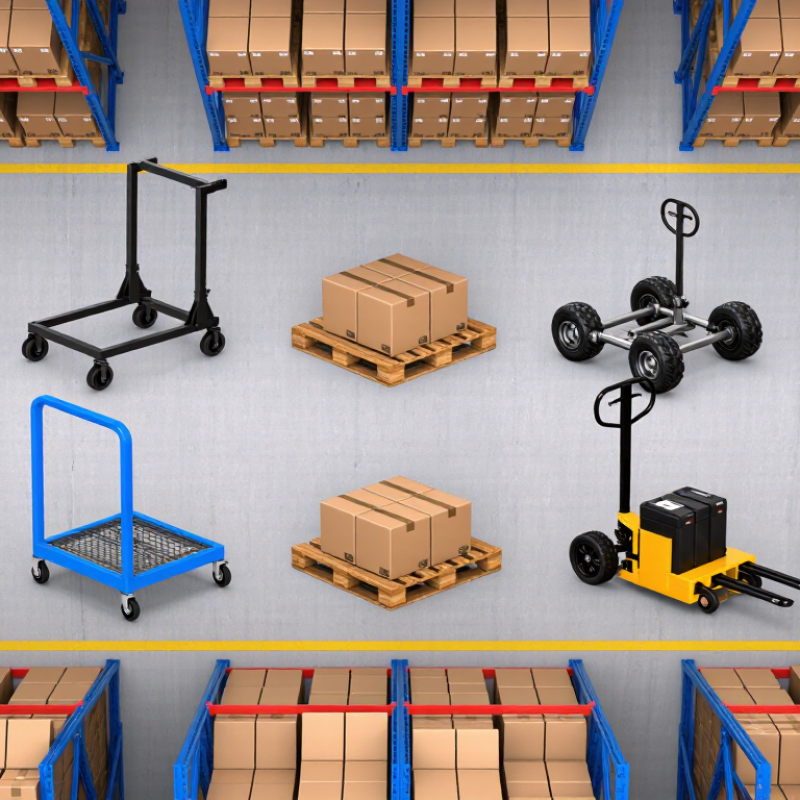
What Are the Top 10 Pallet Dolly Types for Buyers?
Pallet Dolly Basics: Definition, Purpose, and Key Components
A pallet dolly is a wheeled platform that supports and moves loaded pallets across warehouses, docks, and production areas. It reduces lifting, shortens travel paths, and helps operators position goods beside racks or trucks. Common types include standard platform, low-profile, steerable, towable, nesting, lift-top, roller, cage, powered, and custom dollies.
Core components include the deck, caster or wheel set, frame, brake, handle, and load-retention features. Decks may use steel, aluminum, or reinforced polymer. Wheel choice matters. Polyurethane wheels roll quietly on smooth concrete, while larger rubber wheels handle small floor cracks better. A brake should hold the dolly on a slight slope, not merely slow it. In warehouse trials, uneven loads often shift before the frame fails. That detail is easy to miss.
Allied Market Research valued the global material-handling equipment market at about $213.35 billion in 2021 and projected $342.6 billion by 2031. This growth supports wider equipment choices, but more options can confuse buyers. A neat list can still mislead. Match capacity, pallet size, aisle width, turning radius, floor condition, and daily travel distance. Check published load ratings carefully. Do not treat maximum capacity as a comfortable working capacity.
Tips: Measure the loaded pallet first. Test one dolly on your actual floor. Confirm wheel clearance, brake access, and handle height. Ask whether replacement wheels and fasteners are available. A five-minute trial may reveal more than a polished specification sheet.
Pallet Dolly Basics: Definition, Purpose, and Key Components
| No. | Pallet Dolly Type | Typical Load Capacity | Common Deck Size | Typical Caster Configuration | Primary Purpose | Key Components | Main Advantages | Important Buying Considerations |
|---|---|---|---|---|---|---|---|---|
| 1 | Standard Fixed-Deck Pallet Dolly | 500–2,000 kg | 1,000 × 1,200 mm or 1,200 × 1,200 mm |
Four swivel casters, usually with two brakes | Moving loaded pallets over short distances on smooth warehouse floors | Steel or aluminum frame, flat deck, swivel casters, wheel brakes, corner guards | Simple, durable, easy to operate, and suitable for many standard pallet sizes | Check deck dimensions, floor condition, rated capacity, wheel diameter, and frame strength |
| 2 | Low-Profile Pallet Dolly | 300–1,500 kg | 800 × 1,200 mm to 1,200 × 1,200 mm |
Four low-height swivel or fixed casters | Handling pallets where a low loading height is important | Low-mounted deck, recessed casters, reinforced perimeter frame, anti-slip surface | Easy loading and unloading; helps reduce the overall handling height | Verify ground clearance, ramp compatibility, caster protection, and clearance beneath pallets |
| 3 | Heavy-Duty Industrial Pallet Dolly | 2,000–5,000 kg | 1,000 × 1,200 mm to 1,200 × 1,200 mm |
Four to eight heavy-duty casters; brakes or directional locks may be included | Transporting dense machinery, metal products, bulk materials, and very heavy loads | Welded steel chassis, reinforced deck, large load-bearing casters, towing or push points | High structural strength and better stability under demanding loads | Confirm point-load limits, turning radius, floor rating, caster load rating, and empty weight |
| 4 | Pallet Dolly with Side Rails | 500–2,000 kg | Typically 1,000 × 1,200 mm or 1,200 × 1,200 mm |
Four swivel casters, often with two locking brakes | Keeping cartons, bags, or unstable pallet loads positioned during movement | Flat deck, removable or fixed side rails, corner posts, casters, wheel brakes | Provides lateral load retention and reduces the risk of product sliding off | Ensure rail height does not obstruct loading, pallet entry, wrapping, or forklift access |
| 5 | Adjustable-Width Pallet Dolly | 500–2,000 kg | Adjustable to suit several pallet widths; commonly about 800–1,200 mm |
Four or six swivel casters with adjustable frame sections | Handling pallets with different widths or non-standard footprints | Sliding rails, locking pins, telescopic frame members, deck supports, casters | Flexible for mixed pallet inventories and changing load dimensions | Inspect adjustment locks, maximum extension, load distribution, and frame rigidity |
| 6 | Pallet Dolly with Turntable Deck | 500–1,500 kg | Approximately 1,000 × 1,200 mm or a round deck of about 1,000–1,200 mm |
Four swivel casters, sometimes with directional locks | Rotating palletized goods for picking, inspection, wrapping, or positioning | Rotating top platform, bearing assembly, locking mechanism, base frame, casters | Allows load rotation without repeatedly repositioning the entire dolly | Check rotation resistance, deck locking positions, bearing capacity, and operator clearance |
| 7 | Towable Pallet Dolly | 500–2,500 kg per dolly | Commonly 1,000 × 1,200 mm or 1,200 × 1,200 mm |
Fixed or swivel casters with drawbar, hitch, and towing connection | Moving multiple pallet dollies as a train behind a tugger or industrial vehicle | Drawbar, hitch, towing eye, reinforced chassis, caster assembly, safety latch | Improves batch movement efficiency over longer internal routes | Review towing speed, hitch compatibility, train length, braking practice, and turning behavior |
| 8 | Powered Pallet Dolly | 500–2,000 kg | Usually 1,000 × 1,200 mm to 1,200 × 1,200 mm |
Powered drive wheel plus supporting swivel or fixed casters | Reducing manual pushing effort for frequent pallet movement or long indoor routes | Electric motor, battery pack, controller, drive wheel, handle or remote controls, brakes | Reduces operator exertion and can improve movement consistency | Consider battery runtime, charging facilities, speed control, emergency stop, and maintenance access |
| 9 | Stainless Steel Hygienic Pallet Dolly | 300–1,500 kg | Commonly 800 × 1,200 mm or 1,000 × 1,200 mm |
Corrosion-resistant swivel casters with sealed bearings | Moving pallets in food processing, pharmaceutical, clean, or washdown environments | Stainless steel frame, smooth welded surfaces, sealed casters, drainage-friendly deck | Resists corrosion and is easier to clean than many painted-steel designs | Check material grade, weld finish, washdown rating, drainage, chemical resistance, and hygiene requirements |
| 10 | Roller-Deck Pallet Dolly | 500–2,000 kg | Designed around common pallet footprints; typically 1,000 × 1,200 mm or 1,200 × 1,200 mm |
Four swivel casters plus deck rollers or ball-transfer units | Transferring pallets between adjacent workstations, conveyors, or storage lanes | Roller deck, ball-transfer units or rollers, side stops, frame, casters, locking devices | Supports easier lateral pallet transfer with less lifting or dragging | Evaluate roller spacing, pallet bottom-board compatibility, transfer height, load concentration, and safety stops |
Note: Capacity and dimensions are typical purchasing ranges rather than universal specifications. Actual limits depend on frame design, load distribution, caster rating, floor conditions, and the manufacturer’s tested specifications.
A pallet dolly is a wheeled platform for moving loaded pallets across warehouses, docks, and production areas. It reduces lifting and helps position goods near racks or trucks. Simple, but useful.
A standard platform dolly usually fits short moves with boxed goods and stable loads. Fixed wheels work well in straight aisles. Tight corners may expose its weakness.
Choose a low-profile dolly when pallets have limited clearance underneath. Measure the loaded pallet before ordering. A small height mistake can stop the entire route.
A steerable dolly improves control around corners, loading bays, and crowded storage areas. It can help with heavier loads. Turning still requires enough aisle width.
No. Powered models reduce pushing effort across large facilities and repeated routes. They also need charging space, trained operators, and service access. More power can mean more maintenance.
Polyurethane wheels roll quietly on smooth concrete. Larger rubber wheels handle small floor cracks more effectively. Test the wheels on your actual floor, not only a clean showroom surface.
Check the complete dolly rating, not the rating of one wheel. Do not treat maximum capacity as comfortable daily capacity. Uneven loads may shift before the frame fails.
Check deck size, wheel clearance, brake access, handle height, weld quality, and turning radius. Test one loaded dolly through the narrowest route. A five-minute trial may reveal overlooked problems.
A pallet dolly is a compact material-handling platform designed to support, move, and position palletized loads with less manual effort. This guide introduces the basic structure of a pallet dolly, including its deck, casters or wheels, frame, handle, and braking features. It also reviews 10”Pallet Dolly options and other common designs, such as low-profile, heavy-duty, adjustable, powered, warehouse, platform, steerable, stackable, stainless, and specialized models, explaining where each type is most useful.
Pallet dolly designs vary according to load capacity, wheel configuration, maneuverability, and operating environment. Buyers should evaluate rated capacity, pallet size compatibility, floor conditions, turning space, braking performance, maintenance needs, and operator safety before making a selection. The right choice should provide stable load support, smooth mobility, reliable construction, and practical compatibility with the facility’s daily workflow.

 Chidge Dolly