Choosing an Ld3 Container Dolly for Aviation starts with a practical question: will it move your containers safely through the actual ramp environment? IATA reported that global air-cargo demand rose 11.3% in 2024, while available capacity increased 7. იქნ%. The figures appear in IATA’s 2024 year-end air-cargo analysis. They describe a growing workload, not a guarantee that every dolly suits every operation. As IATA Global Head of Cargo Brendan Sullivan stated, “Air cargo demand reached record levels in 2024, with full-year demand up 11.3% compared to 2023.” That market context makes dependable ground equipment worth examining.
For an Ld3 Container Dolly for Aviation, assess LD3 compatibility, rated load, restraint points, braking performance, wheel condition, and turning clearance. Check how the dolly behaves on uneven pavement, in tight staging lanes, and during repeated coupling. A clean specification sheet helps. A hands-on inspection helps more. IATA’s ULD handling guidance and the manufacturer’s operating instructions can inform checks, but neither replaces site-specific evaluation. Ask operators how the unit tracks under load and whether brakes hold on the ramps they actually use. Small details matter. A worn caster can change the feel of a loaded turn; a latch that is awkward with gloves may slow routine handling. There is no single best configuration for every airport. And a specification can look convincing while missing a local operational constraint. Treat this guide as a decision framework, then verify fit, serviceability, and maintenance support before purchase.
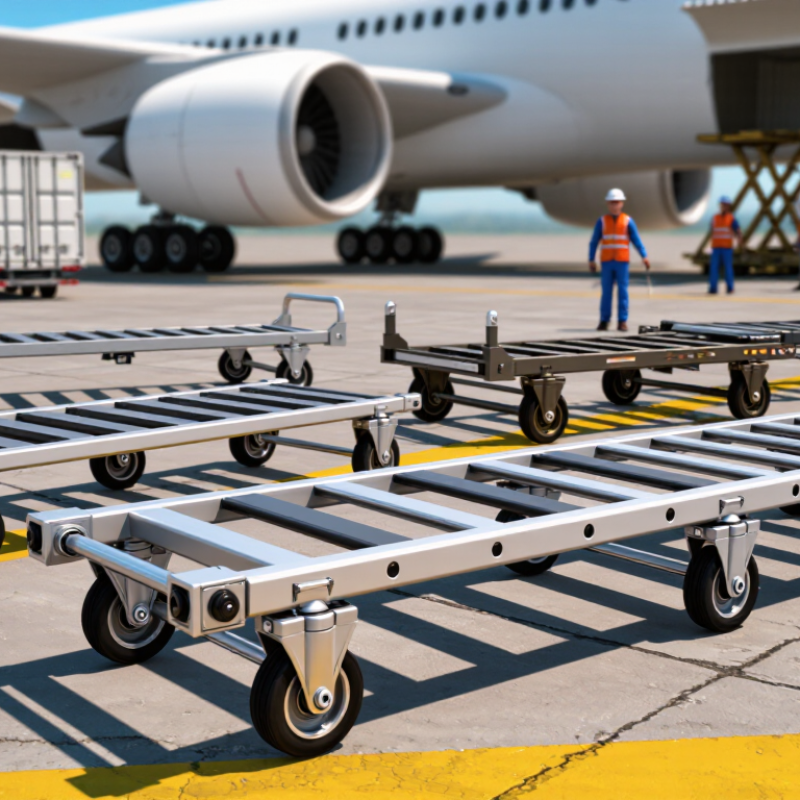
Understanding LD3 Containers and Their Aviation Handling Requirements
How to Choose an LD3 Container Dolly for Aviation?
An LD3, commonly identified as an AKE, is a lower-deck unit load device with a contoured profile. Its typical external dimensions are about 61.5 by 60.4 by 64 inches. The shape helps use aircraft belly space efficiently, but it demands accurate handling. IATA’s ULD Regulations specify requirements for identification, restraint, inspection, and operational control. A dolly must match these conditions, not merely support the container’s footprint.
Load rating comes first. Check the ULD data plate, then include cargo weight, transfer impact, and uneven loading. The dolly’s rated capacity should exceed the maximum gross weight with a practical safety margin. Boeing’s Commercial Market Outlook 2024–2043 forecasts roughly 4% yearly air-cargo traffic growth. That pressure can increase ramp frequency and equipment wear. Select corrosion-resistant frames, smooth rollers, positive locks, and a deck height aligned with aircraft and warehouse interfaces. Small height errors create large handling problems.
Turning radius matters on crowded aprons. So do wheel size, braking performance, tow-bar compatibility, and drainage after rain. IATA’s ULD Regulations also emphasize regular inspection and serviceability checks. In practice, damaged rollers are often noticed late, after movement becomes rough. That is a preventable weakness. I would not choose a dolly from catalog capacity alone. Test it with a loaded LD3, verify lock engagement, and record inspection results. The safest choice may be less convenient, but predictable handling protects both the container and the ramp crew.
Identifying the Dolly Specifications Needed for LD3 Container Transport
Choosing an LD3 container dolly starts with the container, not the towing vehicle. The IATA ULD Regulations 2024 list the LD3’s external footprint at approximately 1,534 by 1,562 millimetres. Its maximum gross weight is about 1,588 kilograms. Your dolly deck must support this footprint without damaging the container’s lower rails. A practical design usually includes a higher rated capacity, such as 2,000 kilograms, to cover uneven loading and braking forces.
Specification checks should include deck length, deck width, roller spacing, side guides, wheel locks, and tow-bar height. The dolly must keep the LD3 stable during turns and aircraft-side positioning. FAA AC 120-85B stresses controlled cargo handling and suitable ground-support equipment. That means checking braking performance, steering response, and surface compatibility, not only rated load. In daily operations, a dolly can appear strong yet move poorly on cracked concrete. I have seen this detail overlooked. It matters.
Tips: Measure the actual LD3 fleet before ordering. Confirm the aircraft door height and loading interface. Select corrosion-resistant components for wet ramps. Test the dolly with a distributed 1,588-kilogram load, then repeat with emergency stops. Record wheel wear and lock engagement during inspections. One weak lock can create an expensive delay. Allow clearance for gloves, safety shoes, and winter clothing. Operators work better when controls remain visible and reachable.
How to Choose an LD3 Container Dolly for Aviation?
Identifying the Dolly Specifications Needed for LD3 Container Transport
Selection guidance: An LD3 dolly should provide a deck that accommodates the ULD footprint of approximately 1,562 × 1,534 mm, while its rated load capacity should meet or exceed the LD3 maximum gross mass of 1,588 kg. Allow additional margin for dynamic loads, uneven loading, braking, and operational conditions. Confirm the exact ULD specification, restraint arrangement, deck height, caster configuration, and aircraft-handling requirements before procurement.
Comparing Dolly Frames, Casters, Brakes, and Weight Capacities
How to Choose an LD3 Container Dolly for Aviation?
A sound frame keeps an LD3 container supported during loading and ground movement. Check that its rails, rollers, and stops match the container’s base and handling system. A frame that flexes under load can make transfers awkward and place extra stress on contact points. Inspect welds and joints, especially near corners. Small details matter.
Caster choice depends on the route. Swivel casters help in tight staging areas, while fixed wheels can track more predictably along straight paths. Wheel diameter and tread also affect movement over floor joints or small debris. Brakes should hold the loaded dolly on the actual operating surface, not just during a quick showroom test. Test each brake, and check that operators can reach it without stepping near moving parts.
Compare rated capacity with the dolly’s intended gross load, including the container and its contents. Allow for uneven cargo distribution and repeated starts or stops; a generous number on a data sheet is not the whole story. Confirm the rating with the manufacturer’s documentation and your handling requirements. One detail is easy to overlook: a dolly may feel stable when empty, yet behave differently once loaded. A careful trial under controlled conditions can reveal that gap.
How to Choose an LD3 Container Dolly for Aviation? - Comparing Dolly Frames, Casters, Brakes, and Weight Capacities
Compare representative LD3 dolly configurations by frame construction, caster arrangement, braking, and rated load. Select a dolly based on the loaded container weight, operating surface, handling method, and applicable ground-support procedures.
| Selection Factor |
Light-Duty Configuration |
Standard Ramp Configuration |
Heavy-Duty Configuration |
| Typical rated capacity |
Approximately 1,000 kg (2,205 lb) |
Approximately 1,500 kg (3,307 lb) |
Approximately 2,000 kg (4,409 lb) |
| Frame construction |
Welded steel frame; suitable for lower-intensity handling where a lighter-duty rating is adequate. |
Reinforced welded steel frame; a practical balance of durability and routine ramp use. |
Heavier-gauge reinforced steel frame with additional cross-members for higher loads and frequent handling. |
| LD3 support and retention |
Support rails or stops positioned to retain the container base during movement. |
Configured to support the LD3 base and restrain it against unwanted movement; verify stop and rail positions against the container design. |
Reinforced support and retention points intended for higher rated loads; confirm compatibility with the specific LD3 variant. |
| Caster arrangement |
Four swivel casters, typically with load ratings selected to exceed the dolly’s maximum applied load. |
Four swivel casters for maneuverability, or a mixed fixed-and-swivel arrangement where directional tracking is preferred. |
Four heavy-duty swivel casters or a fixed-and-swivel layout; caster ratings should account for uneven load distribution and surface conditions. |
| Typical wheel diameter |
About 150 mm (6 in), subject to the selected caster and floor conditions. |
About 150–200 mm (6–8 in); larger wheels can make movement over minor surface irregularities easier. |
About 200 mm (8 in) or larger, where compatible with the frame and operating environment. |
| Brake options |
At least two braked casters for parking; confirm that the brake type suits the work area. |
Two or more braked casters, with total-lock brakes available to restrain both wheel rotation and swivel movement. |
Heavy-duty total-lock brakes or a specified parking-brake arrangement; verify holding performance on the intended surface and grade. |
| Best suited to |
Lower-load transfers and controlled environments with smooth, maintained surfaces. |
Routine airport ground handling where a balance of capacity, maneuverability, and durability is required. |
Higher-load applications, frequent use, or operating conditions that call for a stronger frame and higher-rated casters. |
| Before purchase |
Confirm the maximum gross container load, dolly rating, individual caster ratings, LD3 base compatibility, brake requirements, overall dimensions, and suitability for the planned floor or ramp conditions. Do not exceed the lowest applicable component rating. |
Note: Capacity figures and component details above are representative comparison values, not universal LD3 dolly specifications. Actual ratings, dimensions, and configurations vary by design. Use the equipment manufacturer’s documentation and applicable airport procedures to confirm suitability.
Evaluating Safety, Compatibility, Durability, and Maintenance Features
Choosing an LD3 Container Dolly for Aviation
Safety should guide every specification. Check the rated load, locking system, wheel stability, and tow-bar connection. The container must sit evenly, without rocking or sliding during movement. Inspect welds and frame joints closely. Small cracks can grow under repeated ramp loads. Braking performance also matters, especially on sloped or wet surfaces. A safety feature is useful only when operators can understand and use it quickly.
Compatibility prevents expensive handling problems. Confirm the dolly’s dimensions, roller spacing, guide rails, and restraint height match LD3 containers. The turning radius should suit your warehouse lanes and aircraft servicing area. Strong steel construction supports long service, but corrosion protection deserves equal attention. Water, de-icing residue, and hydraulic fluid can damage exposed surfaces. I have seen durable equipment fail early because drainage was poor. Specifications alone do not reveal every practical weakness.
Tips
Inspect casters, pins, rollers, and brakes before each shift. Lubricate moving parts according to the maintenance schedule. Record unusual noise, uneven rolling, or loose hardware. Do not ignore small defects. A short trial with a loaded container can reveal alignment problems that an empty test misses. Maintenance records should identify dates, findings, repairs, and responsible personnel. Recheck the dolly after heavy use. One overlooked wheel can affect the whole handling process.
Selecting an LD3 Dolly Based on Airport Operations and Budget Constraints
How to Choose an LD3 Container Dolly for Aviation?
Selecting an LD3 dolly starts with the airport’s daily rhythm, not its catalogue price. IATA reported an 11.3% rise in global air cargo demand during 2024, while available capacity grew 7.4%. Higher traffic can expose weak braking, poor steering, and slow transfer points. Observe the apron during peak waves. Measure queue length, tow distances, surface quality, and average LD3 movements per hour. Small delays multiply quickly.
For busy hubs, choose a dolly with a suitable load rating, positive locking system, low deck height, and reliable swivel performance. IATA’s ULD Regulations emphasize safe restraint, handling, and equipment compatibility. The frame should support standard LD3 dimensions without excessive movement. Check turning space beside aircraft stands. Also inspect brake response on ramps, drainage holes after rain, and corrosion around welds. These details matter more than polished paint.
Budget limits require total-cost thinking. A lower purchase price may bring higher tire replacement, inspections, and downtime. Compare five-year costs, including spare parts, labor, training, and lost operating hours. Airport operations reports regularly identify ground handling as a major source of turnaround pressure, although exact impacts vary by station. Do not over-specify every dolly. That wastes capital. Yet choosing the lightest option can be a false economy. A practical assessment should include a loaded trial, not only paperwork. My own preference would be challenged here: a robust dolly is valuable, but unused capacity still consumes budget. Review the decision after seasonal peaks.
FAQS
An LD3 is a lower-deck aviation container with a curved, space-saving profile. It usually measures about 1,534 by 1,562 millimetres at its footprint. Its maximum gross weight is approximately 1,588 kilograms.
The dolly should exceed the container’s maximum gross weight. A rated capacity near 2,000 kilograms provides useful allowance. Include cargo weight, uneven loading, braking forces, and transfer impacts. Capacity alone is not enough.
Check deck length, deck width, roller spacing, side guides, and clearance. The rollers must support the container’s lower rails without damaging them. Confirm the deck height matches aircraft and warehouse interfaces. A small height error can stop a transfer.
Brakes must hold a fully loaded dolly on the real operating surface. Test them on ramps, cracked concrete, and slight slopes. Controls should remain visible and reachable. A quick showroom test can mislead.
Swivel casters help with tight staging areas. Fixed wheels usually track better on straight routes. Larger wheels handle floor joints and small debris more smoothly. Wet surfaces can still reduce control.
Inspect rails, rollers, stops, welds, and corner joints. A flexible frame may stress the container’s contact points. Look for corrosion, bent parts, and unusual movement. Small damage grows.
Test it with a distributed load close to 1,588 kilograms. Repeat movement tests with controlled emergency stops. Check lock engagement, steering response, brake holding, and tow-bar alignment. Record the results, even when everything seems normal.
Inspect the dolly regularly and after unusual impacts. Check wheel wear, roller condition, locks, brakes, and corrosion. Operators often notice damaged rollers too late. That weakness is preventable.
Conclusion
Choosing the right Ld3 Container Dolly For Aviation requires a clear understanding of LD3 containers, their dimensions, loading points, and the demands of airport ground operations. Start by confirming that the dolly matches the container’s size, base structure, and handling method. Important specifications include platform dimensions, load capacity, frame strength, caster design, braking performance, and maneuverability. A stable frame and properly rated casters help support smooth movement across different ramp and warehouse surfaces.
Safety, compatibility, durability, and maintenance should also guide the selection. Look for secure container restraints, reliable brakes, corrosion-resistant materials, replaceable wear parts, and easy access for inspections and servicing. Airports with frequent transfers may prioritize heavy-duty construction and low maintenance, while smaller operations may focus on cost efficiency and flexible storage. By balancing operational frequency, working conditions, safety requirements, expected service life, and available budget, operators can select an LD3 dolly that supports efficient, dependable, and controlled container transport.

 Chidge Dolly