Moving goods across a warehouse floor looks simple. It is not.
A reliable Pallet Dolly can reduce lifting, improve staging flow, and support safer internal transport. The need is growing as supply chains become more automated and space becomes more expensive. MHI’s 2024 Annual Industry Report found that 55% of supply chain professionals planned to increase investment in technology and innovation. That investment does not always mean robotics. Sometimes, a durable, well-designed dolly solves a daily bottleneck.
The seven options in this guide are assessed for practical global purchasing. Key factors include rated capacity, platform dimensions, caster quality, turning radius, braking performance, corrosion resistance, and replacement-part availability. A dolly may carry 1,000 kilograms on paper, yet perform poorly on uneven concrete. Wheel material matters. So does the operator’s grip.
Safety deserves equal attention. The U.S. Bureau of Labor Statistics recorded 1,184 fatal work injuries in transportation and material-moving occupations during 2023. This figure is not a global pallet-handling benchmark, but it shows why equipment selection cannot focus only on price. Buyers should also verify load testing, operating instructions, packaging quality, and supplier support.
There is no universal winner. A compact steel model may suit retail backrooms, while a heavy-duty dolly with polyurethane casters may better fit distribution centers. Some specifications remain unclear across product listings. That is worth questioning. This comparison highlights strong choices, practical limitations, and the details buyers should confirm before placing an international order.
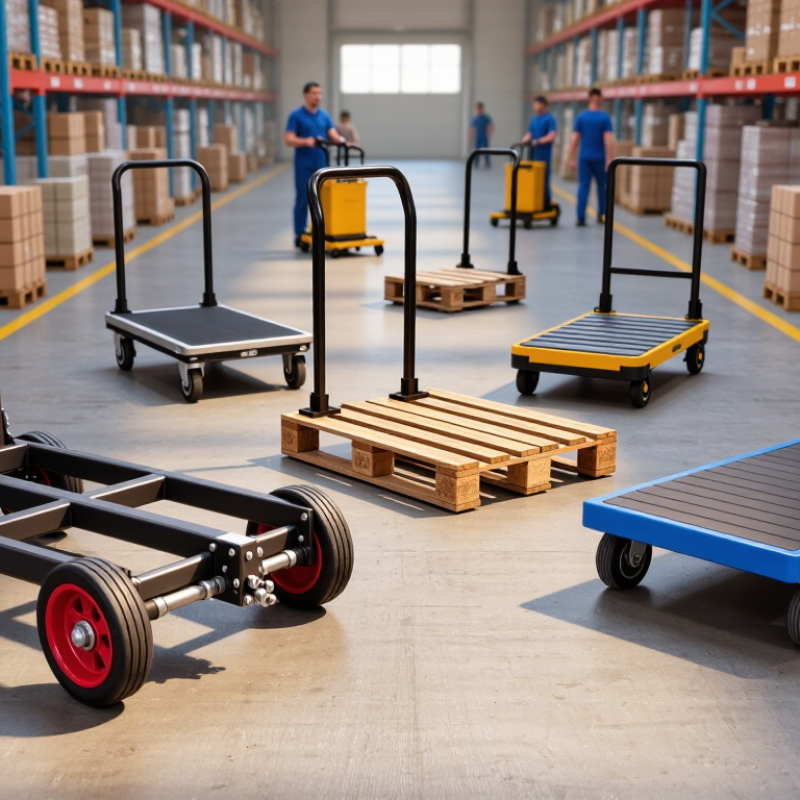
A pallet dolly is a low-profile wheeled platform designed to move loaded pallets across warehouses, loading areas, and short-distance production zones. It usually has a steel or reinforced frame, swivel casters, and a flat deck or support rails. Some models include brakes, tow points, or fork-entry openings.
The working principle is simple. Operators place a pallet onto the dolly, then push or pull it manually. The casters transfer the load into rolling movement, reducing lifting and dragging effort. A 1,000-kilogram load can still create dangerous momentum, especially on slopes or uneven floors. It is not a substitute for a forklift. The correct choice depends on pallet size, floor condition, load distribution, and movement frequency. ISO 6780 identifies common pallet dimensions, including 1,200 × 800 millimeters and 1,200 × 1,000 millimeters. However, actual regional pallet practices vary.
Tips: Check the rated capacity against the complete load, not the pallet alone. Confirm deck clearance and caster diameter before ordering. MHI’s 2024 Annual Industry Report found that 55% of surveyed supply-chain professionals planned to increase technology investment. That trend also supports practical equipment upgrades, but automation does not remove basic inspection needs. Examine welds, wheel bearings, brakes, and corrosion protection. A common mistake is choosing maximum capacity while ignoring turning space. We have seen small wheels perform poorly on cracked concrete. Sometimes, a simpler dolly works better. Always request load tests and dimensional drawings from the supplier.
| Option | Dolly Type | Typical Load Capacity | Typical Platform Size | Wheel Configuration | Typical Wheel Material | Best Use | Key Selection Considerations |
|---|---|---|---|---|---|---|---|
| 1 | Low-Profile Rigid Pallet Dolly | 500–1,000 kg | Approx. 1,200 × 800 mm or 1,200 × 1,000 mm | 4 fixed or swivel casters | Polyurethane or rubber | Warehouse pallet staging and short-distance movement | Choose a deck that supports the pallet runners without creating unstable overhang. A low deck height reduces lifting effort but requires a compatible pallet jack or loading method. |
| 2 | Heavy-Duty Steel Pallet Dolly | 1,000–2,000 kg | Approx. 1,200 × 1,000 mm or 1,200 × 1,200 mm | 4–6 heavy-duty casters | Cast iron, steel, or polyurethane | High-load industrial handling on smooth floors | Verify the rated capacity per dolly, not only the individual caster rating. Reinforced frames and welded corner supports are important for concentrated loads. |
| 3 | Adjustable-Width Pallet Dolly | 500–1,500 kg | Approx. 800–1,200 mm adjustable width | 4 swivel casters or 2 fixed plus 2 swivel casters | Polyurethane or nylon | Facilities handling multiple pallet footprints | Confirm the adjustment range, locking method, and safe working load at each width setting. Locking pins or mechanical stops should prevent unintended movement. |
| 4 | Swivel-Caster Pallet Dolly | 500–1,000 kg | Approx. 1,200 × 800 mm | 4 swivel casters, often with brakes | Rubber or polyurethane | Tight aisles, retail backrooms, and work-cell positioning | Four swivel casters provide excellent maneuverability but can be harder to control in a straight line under heavy loads. Brakes should be applied during loading and unloading. |
| 5 | Fixed-and-Swivel Combination Dolly | 750–1,500 kg | Approx. 1,200 × 1,000 mm | 2 fixed casters plus 2 swivel casters | Polyurethane or rubber | Longer travel paths requiring directional stability | The fixed casters help the dolly track in a straight line, while the swivel casters improve turning. Select a handle or steering accessory if operators must reposition heavy pallets frequently. |
| 6 | Stainless-Steel Hygienic Pallet Dolly | 500–1,000 kg | Approx. 1,200 × 800 mm or 1,200 × 1,000 mm | 4 swivel or 2 fixed plus 2 swivel casters | Stainless steel, nylon, or non-marking polyurethane | Food, pharmaceutical, clean, and wash-down environments | Look for corrosion-resistant construction, sealed bearings, smooth welds, and drainage-friendly surfaces. Confirm chemical and temperature compatibility before using cleaning agents. |
| 7 | Low-Noise Non-Marking Dolly | 300–750 kg | Approx. 1,200 × 800 mm | 4 swivel casters, normally with brakes | Elastic rubber or polyurethane | Offices, hospitals, hotels, supermarkets, and finished floors | Non-marking wheels reduce floor damage and noise. Check rolling resistance, wheel hardness, and floor cleanliness because soft wheels can require more pushing force under heavy loads. |
Manual dollies suit light movement and occasional repositioning. Low-profile models fit beneath pallets with little clearance. Steerable versions help in narrow aisles. Towable models connect for longer internal routes. Electric, hydraulic lift, and nesting designs solve different needs.
Include the pallet, goods, and movement frequency. Do not rely on maximum capacity alone. Keep the load centered over the frame. A heavy load may turn poorly or damage the floor. Our first estimate may be wrong.
Polyurethane wheels roll quietly on smooth concrete. They usually reduce floor marks. Rubber wheels can provide better grip on uneven surfaces. Larger wheels cross gaps and damaged thresholds more smoothly. Check hardness, bearings, and axle strength.
Measure pallet length, width, and underside clearance. Check the platform size and wheel spacing. Common pallet sizes vary by market. A low deck improves stability but may scrape thresholds. Test a real pallet before ordering many units.
Compare starting force, handle height, steering effort, and brake access. Tight turns should not require excessive pushing. Repeated effort can cause fatigue. Worker feedback matters. Laboratory figures may miss real aisle problems.
Electric models reduce pushing effort during repeated daily movement. They require charging access and trained operators. Hydraulic models raise pallets slightly for alignment or transfer. Inspect seals and lifting parts regularly. More advanced is not always better.
Check welds, fasteners, wheels, brakes, and frame alignment before each shift. Keep feet away during positioning. Remove debris from wheel paths. Confirm static and moving load ratings. Do not treat a confident guess as a safety check.
Request inspection records, repair history, load tests, and operator comments. Confirm replacement wheels and parts are available locally. Inspect corrosion protection and damaged coatings. Use visible inspection tags and simple schedules. A checklist helps, but it cannot replace training.
Review packaging, user instructions, conformity documents, and voltage requirements. Confirm compatibility with local pallet sizes. Ask about after-sales support and spare parts. Test the dolly on smooth and rough floors. A small site trial can reveal noise and turning resistance.
A Pallet Dolly is a compact material-handling platform designed to support and move palletized goods efficiently across warehouses, production areas, loading zones, and retail facilities. This guide explains how pallet dollies work and introduces seven major types, including fixed, swivel, locking, low-profile, heavy-duty, adjustable, and specialized models. Each type offers different advantages in maneuverability, stability, floor protection, and load handling, helping global buyers match equipment to their operating environment.
The article also outlines the key factors for comparing performance, such as load capacity, wheel design, frame strength, platform dimensions, braking systems, and ease of movement. Safety standards, durable materials, corrosion resistance, maintenance requirements, and replacement-part availability are also considered. By evaluating workplace conditions, pallet sizes, floor surfaces, transport frequency, and regional purchasing needs, buyers can select a reliable Pallet Dolly that improves efficiency, supports safe handling, and delivers long-term value.

 Chidge Dolly